Age-related Macular Degeneration (AMD)
One of the leading causes of blindness for people over 50.
Age-related macular degeneration (AMD) is the leading cause of blindness in men and women over age 50.
Even though AMD is common among older people, it’s not as well known as cataracts — another eye disease that occurs more often with age. But while cataracts can be treated and “cured,” there’s no cure for AMD. Instead, people who have AMD require treatments that help slow the progression of the disease, which is why early detection is very important.
If you are concerned about macular degeneration, call Infinity Eye Care or schedule your appointment online.
What is age-related macular degeneration?
Age-related macular degeneration — abbreviated as AMD — is a disease of the retina, the light-sensitive portion of your eye. The retina is located at the back of the eye, and the macula is a small area near the very center. Your macula is responsible for your central vision.
In AMD, the macula loses its ability to detect light, resulting in a partial or total loss of central vision. People with late-stage AMD are unable to see objects straight in front of them, making it difficult to perform many activities, like using a computer, reading, driving, or recognizing faces.
AMD typically causes no symptoms until vision begins to fade. Having routine eye exams, especially over age 50, is important for catching AMD as early as possible.
What are the risk factors for AMD?
Age is the biggest risk factor for AMD, followed by having a family history of AMD. You’re also at greater risk of developing AMD if you are:
- Caucasian (white)
- Female
- Have had prolonged sun exposure
- A smoker or past smoker
- Genetic predisposition
Can I reduce my risks of developing AMD?
One of the most important things you can do is have regular eye exams to monitor the health of your retinas.
Taking specific “eye vitamins” may help slow the progression of AMD, and it’s also important to take care of your overall health. Quitting smoking, exercising regularly, maintaining a healthy weight, and controlling your blood pressure and your cholesterol are important lifestyle changes you should consider.
You should also wear sunglasses that protect you from UVA and UVB rays and use blue light protection when operating a computer or your cell phone.
How is AMD treated?
AMD occurs in different stages, and there are two types of AMD: dry and wet. The dry type is much more common, but the wet type is more severe and also develops more quickly.
If you have the wet form of AMD, medications or laser therapy may help slow your vision loss. Otherwise, treatment focuses on monitoring the progression of the disease, along with taking nutritional supplements and incorporating the lifestyle changes listed above.
How is AMD detected?
Dilated eye exams allow your eye doctor to look at your retina so they can check for changes associated with AMD, and until recently, those exams were the only tool eye doctors had to detect this disease.
Today, there are more advanced computer-based options that enable your eye doctor to identify the very earliest signs of AMD. At Infinity Eye Care, we offer the following for diagnosis:
Optomap®
At Infinity Eye Care, we use Optomap® retinal imaging to evaluate the health of your retina and help detect age-related macular degeneration (AMD) and other sight-threatening eye diseases at their earliest stages. Optomap is a quick, comfortable, and non-invasive imaging technology that captures an ultra-widefield, high-resolution photograph of the retina in seconds-often without the need for dilation. Unlike a traditional retinal examination, which provides a limited view, Optomap allows our doctors to examine up to 200 degrees of the retina in a single image, giving us a much more comprehensive view of the back of your eye.
These detailed retinal images help us identify early signs of macular degeneration, including drusen (small yellow deposits beneath the retina), pigment changes, and other abnormalities that may develop long before noticeable vision loss occurs. Optomap images also serve as a permanent record of your retinal health, allowing us to compare your eyes year after year and detect even subtle changes over time. In addition to screening for macular degeneration, Optomap can aid in the detection of retinal tears, retinal detachments, diabetic eye disease, glaucoma, and other conditions that can threaten your vision.
While Optomap provides an exceptional overview of the retina, it is often used together with Optical Coherence Tomography (OCT) to give our doctors the most complete assessment possible. By combining ultra-widefield retinal imaging with detailed cross-sectional scans of the macula, we can detect retinal disease earlier, monitor changes more accurately, and develop personalized treatment plans to help preserve your vision for years to come.
OCT
Optical Coherence Tomography (OCT) is one of the most advanced technologies available for detecting and monitoring age-related macular degeneration (AMD). Often described as an “optical ultrasound,” OCT uses light waves instead of sound to create detailed, cross-sectional images of the retina and macula. This allows our doctors to see the individual layers of retinal tissue with remarkable precision, often revealing subtle changes long before they can be detected during a routine eye examination or before vision is noticeably affected.
By identifying the earliest signs of macular degeneration, OCT helps us diagnose the disease sooner, monitor its progression over time, and recommend the most appropriate treatment or management plan to help preserve your vision.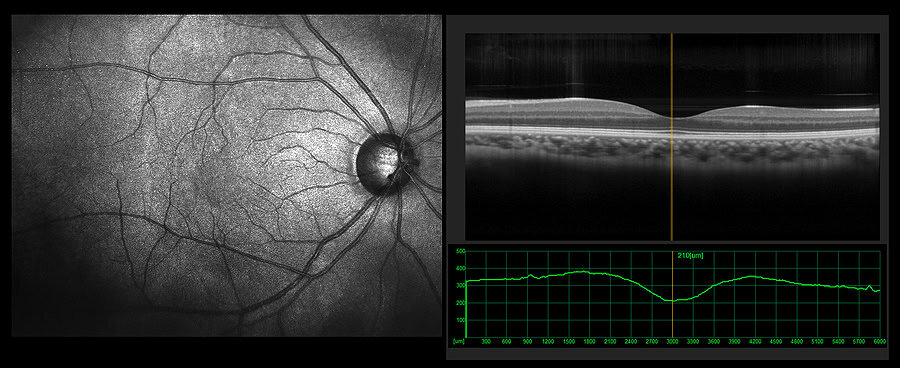
At Infinity Eye Care, we want all our patients to enjoy the best possible vision at every age. To learn more about AMD screening in Indianapolis or to schedule an eye exam, give us a call or book your appointment online below.